
Introduction:
What is Generative AI? Generative AI is transforming the way we create content, automate tasks, and even solve complex problems. Unlike traditional AI, which analyzes or classifies data, Generative AI produces new content such as text, images, audio, or even code. In this guide, we’ll explain what Generative AI is, how it works, provide examples, explore its applications, and discuss ethical considerations.
Section 1: What is Generative AI?
- Definition: AI systems that can generate new data rather than just analyze existing data.
- Difference from traditional AI: Traditional AI predicts or classifies; Generative AI creates.
- Key technologies: Neural Networks, Transformers, Large Language Models (LLMs).
Example: ChatGPT writing an essay, DALL·E generating images, GitHub Copilot coding.
Section 2: How Generative AI Works
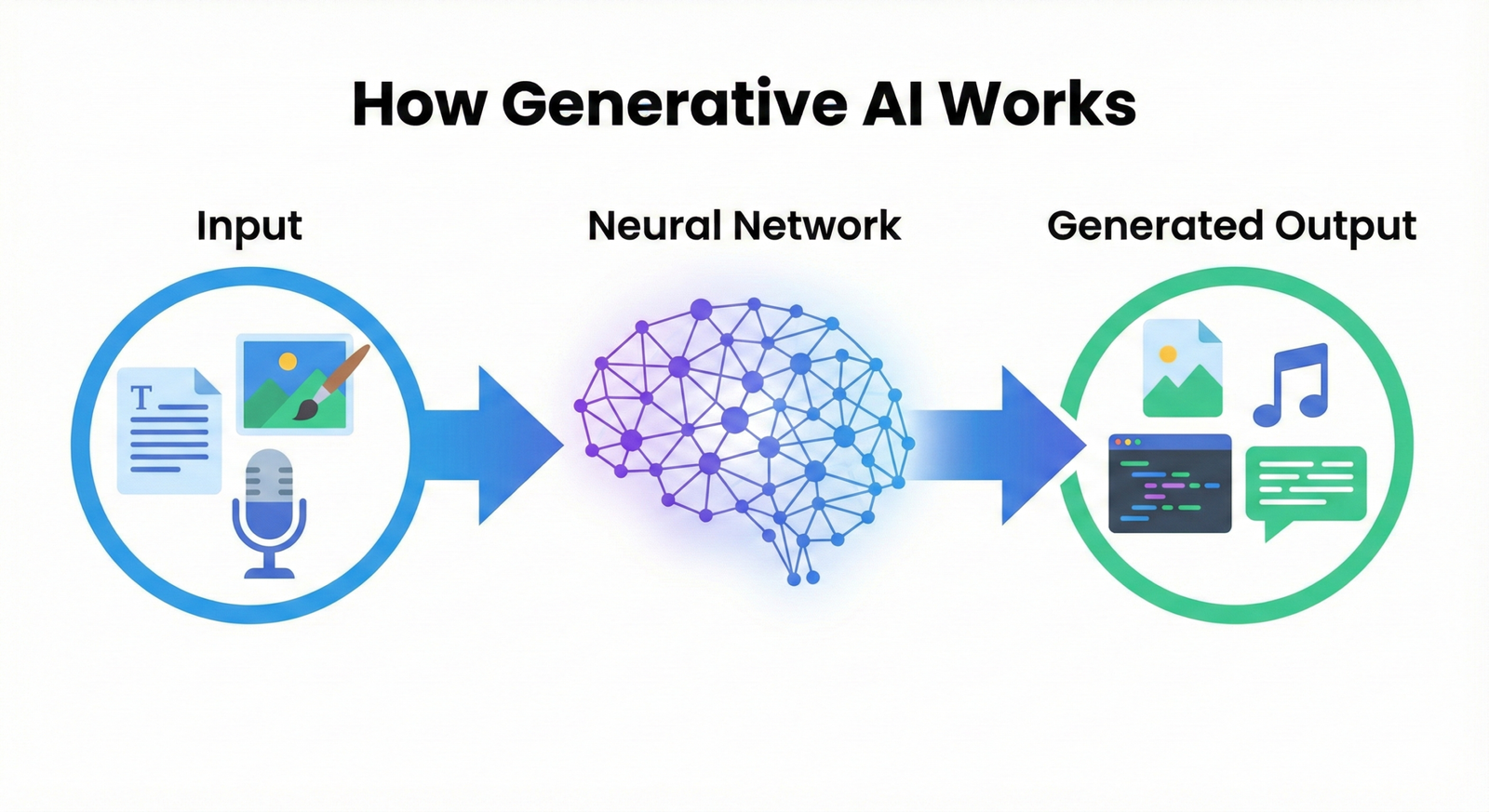
- Trained on large datasets to learn patterns.
- Uses deep learning neural networks to generate content.
- Outputs are probabilistic predictions based on patterns learned.
Visual Suggestion: Flow diagram showing input → neural network → generated output.
Section 3: Real-World Examples
- Text Generation: ChatGPT, Jasper.ai
- Image Generation: DALL·E, MidJourney
- Music/Audio: AIVA, Amper Music
- Code Generation: GitHub Copilot, CodeWhisperer
Section 4: Applications of Generative AI
- Business: Content automation, marketing, product design
- Education: Personalized tutoring, automated study materials
- Healthcare: Drug discovery, medical image synthesis
- Creative Arts: Writing, art, music composition
Section 5: Limitations & Ethics
- Bias in AI outputs
- Misuse for deepfakes, misinformation
- Reliability issues
- Copyright & intellectual property concerns
Section 6: Future Trends
- More personalized AI content creation
- Integration in everyday tools
- AI-driven collaboration in workplaces
- Expansion of open-source Generative AI models
Conclusion:
Generative AI is no longer a futuristic concept—it is actively shaping industries and creativity. Understanding how it works, its applications, and limitations can help individuals and businesses leverage this technology responsibly.
Call-to-Action:
Try experimenting with a Generative AI tool today! Comment below which AI tool you’ve used or want to try.